When a JWT looks structurally correct but my API reports invalid issuer, issuer mismatch, or a generic 401 after signature verification, I treat iss as a trust-boundary problem rather than a formatting problem.
The question I am trying to answer is not simply:
What string is in the
issclaim?
It is:
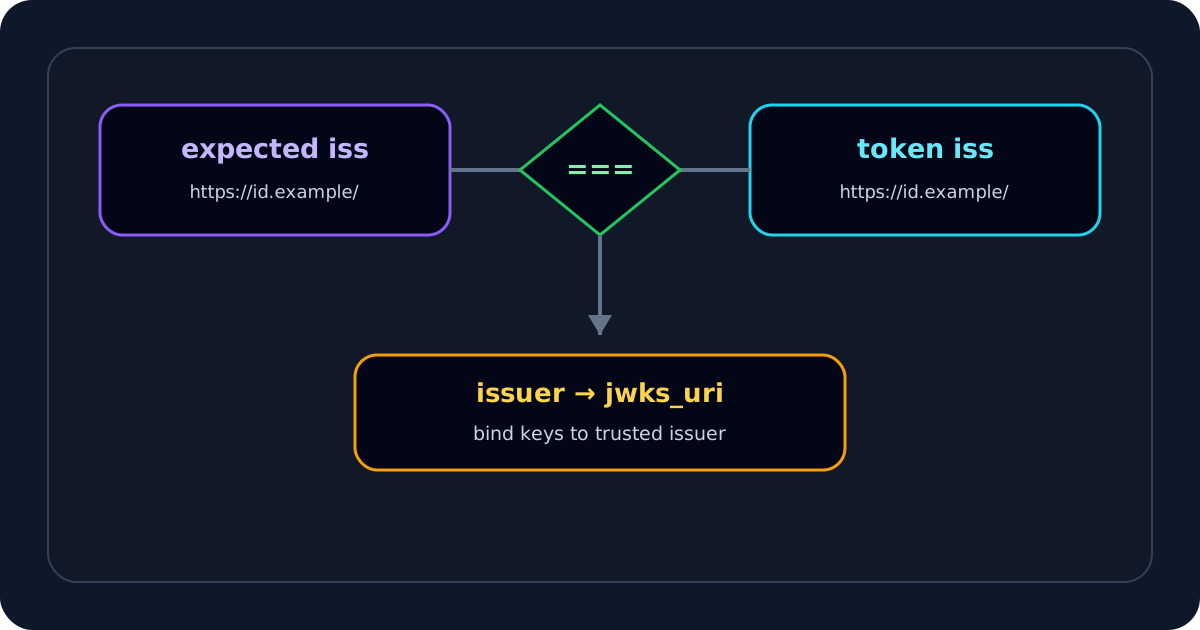
Is this the exact issuer my application is configured to trust, and did I verify the token with keys that actually belong to that issuer?
That second part is important. RFC 8725 says that when a JWT contains an issuer claim, the application must validate that the cryptographic keys used for the JWT belong to that issuer.
If I already know the expected issuer, I start with the JWT Debugger or the JWKS Validator and compare it directly with the token.
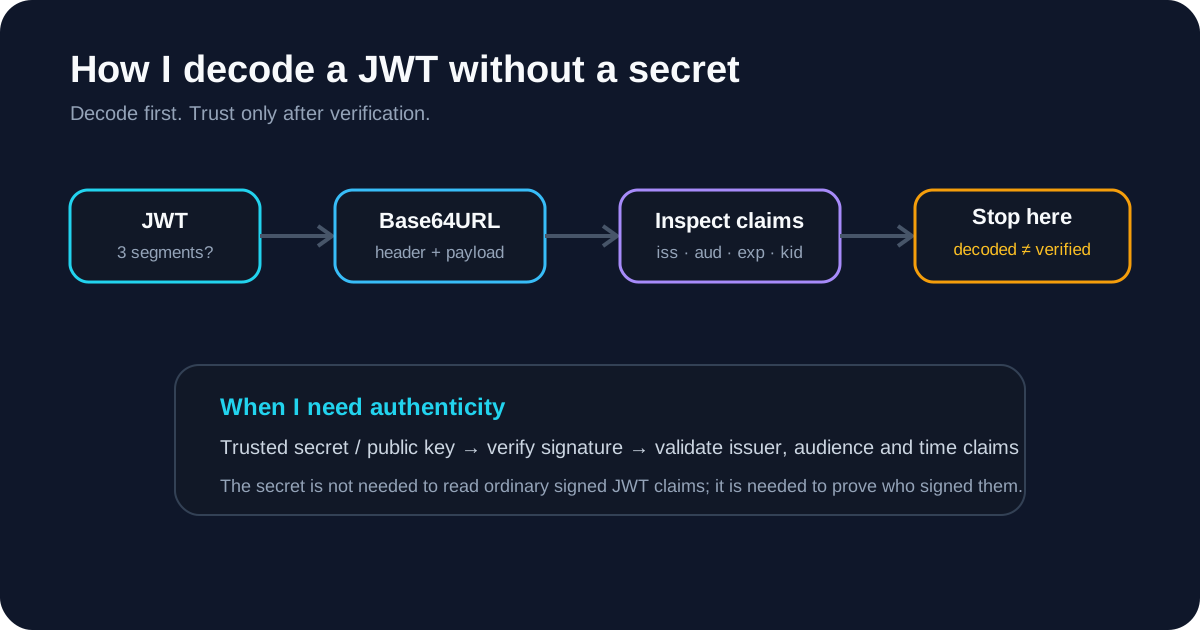
Step 1: I decode iss, but I do not trust it yet
I first inspect the payload with the JWT Decoder:
{
  "iss": "https://login.example.com/",
  "sub": "user_123",
  "aud": "api://orders",
  "exp": 1789203600
}
RFC 7519 defines iss as the Issuer claim. It identifies the principal that issued the JWT.
At this stage I use iss only as evidence for debugging. Because I have not necessarily verified the signature yet, an attacker could have typed any issuer string into a forged payload.
I never make a security decision merely because the decoded issuer URL looks familiar.
Step 2: I identify the issuer my application actually expects
Next I check the resource server configuration.
I want one authoritative expected value, for example:
https://login.example.com/
Then I compare it with the token exactly.
A common bug is that developers compare "roughly equivalent" issuer URLs even though the authentication library expects an exact identifier.
Examples that may be different values include:
https://login.example.com
https://login.example.com/
https://login.example.com/tenant-a
https://login.example.com/tenant-b
Whether normalization is allowed depends on the protocol/profile and library. I avoid silently changing issuer strings unless the system specification explicitly says to do so.
If the configured expected issuer is wrong, changing the token is not the right fix. I correct the application or identity-provider configuration.
Step 3: I check for dev, staging and production mix-ups
This is one of the first real-world configuration problems I look for.
A development token can look completely legitimate:
{
  "iss": "https://login.dev.example.com/",
  "aud": "api://orders-dev"
}
but production may trust:
https://login.example.com/
If I accidentally reuse an access token from another environment, several things can fail at once:
- issuer mismatch;
- audience mismatch;
kidnot found;- signature verification failure;
- missing production scopes.
That is why issuer debugging often explains other JWT errors at the same time.
When I see both kid not found and issuer mismatch, I investigate the environment before I start changing cryptographic code.
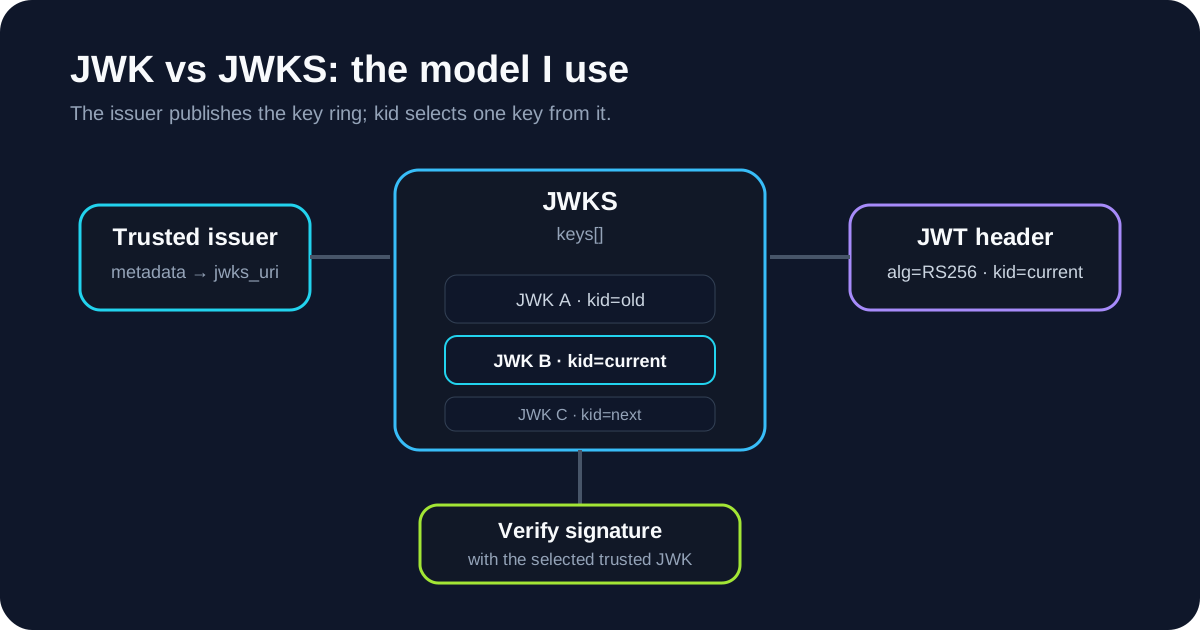
Step 4: I bind the trusted key set to the issuer
This is the step that turns issuer checking from a string comparison into an actual trust model.
For OAuth authorization server metadata, RFC 8414 defines an issuer identifier and an optional jwks_uri that points to the server's public JWK Set.
Conceptually, the trust path I want is:
application trusts issuer A
        ↓
issuer A metadata
        ↓
issuer A jwks_uri
        ↓
key selected from issuer A JWKS
        ↓
JWT signature verified
I do not want this:
JWT says iss = A
        ↓
JWT says fetch some arbitrary key
        ↓
signature passes with attacker's key
        ↓
accept token
The token is untrusted input. My application configuration decides which issuers and key sources are trusted.
The JWKS Validator reflects this model by making me provide the JWKS source explicitly. It never auto-follows a token-provided jku or x5u URL.
Step 5: I verify the signature before trusting issuer-dependent claims
A decoded iss helps me locate the problem, but I only treat claims as authenticated after the signature has been verified with trusted key material.
If the JWT uses RS256 and contains:
{
  "kid": "prod-key-2026-09"
}
I select that kid from the trusted issuer's JWKS and verify the signature.
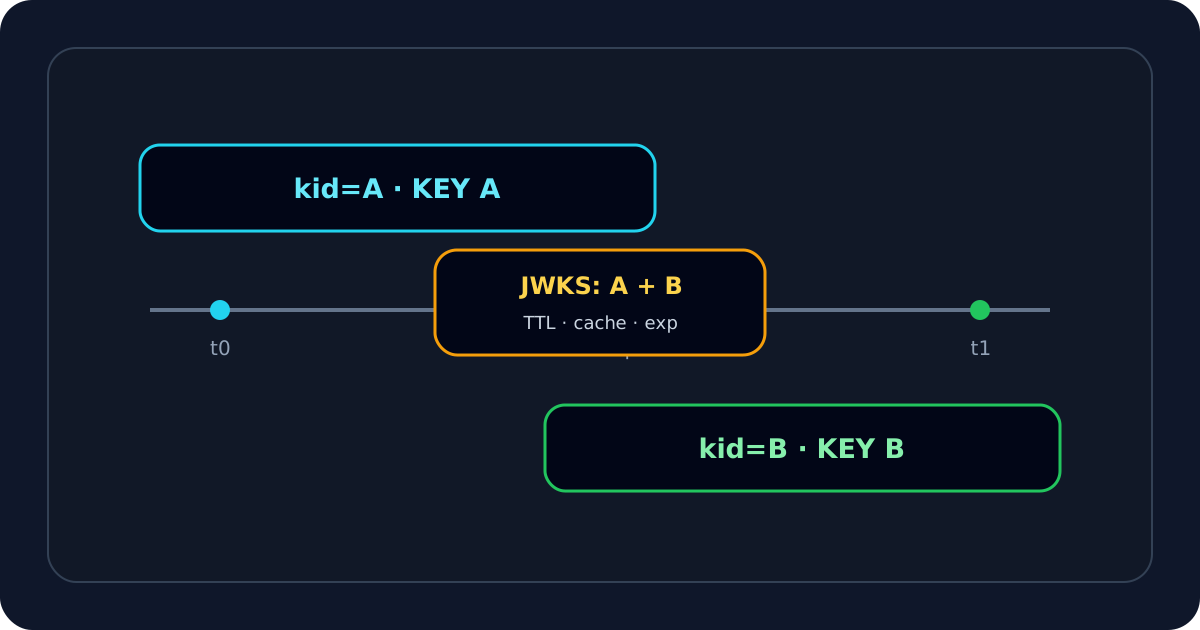
If the key is missing, I follow the JWT kid debugging flow and check rotation, caching and environment mix-ups.
If the key is present but the signature fails, I use the JWT invalid signature guide.
The important point is that issuer validation and signature verification support each other:
- issuer configuration tells me which keys are trusted;
- the trusted keys authenticate the signed issuer claim.
Step 6: I compare the issuer after cryptographic verification
Once the signature is verified with an issuer-bound trusted key, I compare the authenticated iss claim with the configured expected issuer.
Conceptually:
signature verified with issuer A key  ✓
iss == configured issuer A            ✓
If instead I get:
signature verified                    ✓
iss == configured issuer              ✕
I still reject the token.
A valid signature does not mean the token belongs to the trust domain my API expects. A platform may have many tenants, issuers, applications or token profiles that use valid cryptographic keys.
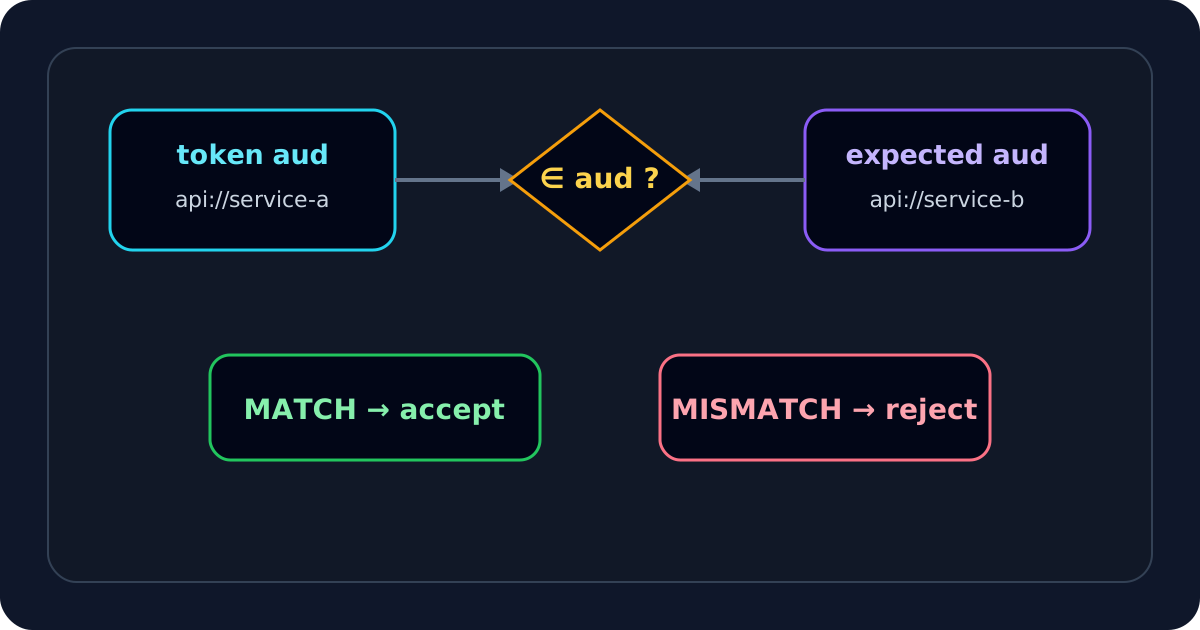
Step 7: I do not confuse issuer and audience
After I fix an issuer problem, the next failure is often audience validation.
These claims answer different questions:
iss— who issued the token?aud— who is the token intended for?
For example:
{
  "iss": "https://login.example.com/",
  "aud": "api://billing"
}
can be correctly issued by my trusted identity provider but still be wrong for my Orders API.
So my normal validation sequence does not stop after issuer:
trusted signature
      ↓
issuer
      ↓
audience
      ↓
exp / nbf
      ↓
token type + scopes/roles
If aud is the problem, I use the JWT audience mismatch guide.
Step 8: I check multi-tenant issuer behavior carefully
Multi-tenant identity systems can make issuer validation more subtle.
I look for questions such as:
- does each tenant have a unique issuer identifier?
- does the library expect a tenant-specific issuer or a common authority?
- does the JWKS contain keys shared across tenants?
- does the API explicitly allow more than one issuer?
- is issuer selection based on trusted configuration or on untrusted token input?
I avoid making issuer validation "flexible" by accepting any issuer under a broad hostname unless the application's security model explicitly defines that behavior.
If multiple issuers are intentionally supported, I maintain an allowlist and bind each accepted issuer to the appropriate metadata/key-discovery policy.
Step 9: I investigate slash, path and casing assumptions
Issuer identifiers are strings with protocol-specific rules. Authentication libraries often perform exact matching.
So if I see an apparently impossible mismatch, I compare the raw values character by character:
configured: https://id.example.com/tenant/
token iss:  https://id.example.com/tenant
I also check:
- trailing slash;
- tenant path;
- scheme (
httpsvshttp); - hostname/environment;
- accidental whitespace in configuration;
- old issuer value after migration.
I do not "solve" these by lowercasing or trimming arbitrary parts of issuer URLs unless the governing specification permits it.
Step 10: I read the authorization-server metadata when available
When the system supports standardized metadata, I compare:
configured issuer
metadata issuer
JWT iss
RFC 8414 requires the metadata issuer to match the authorization server issuer identifier used for the metadata request. The metadata can also provide jwks_uri.
This gives me a useful diagnostic triangle:
expected issuer ───── JWT iss
       │
       │
metadata issuer + jwks_uri
If these values disagree, I know I have a configuration/discovery problem before I blame the JWT library.
What I do not do to "fix" an issuer error
There are a few shortcuts I explicitly avoid:
- I do not disable issuer validation.
- I do not accept every issuer that can produce a cryptographically valid signature.
- I do not dynamically trust a JWKS just because the unverified
isspoints to it. - I do not edit
issinside the JWT and reuse the original signature. - I do not replace issuer validation with audience validation; they solve different problems.
These shortcuts can turn a debugging issue into a trust vulnerability.
My issuer-validation checklist
When I need to debug iss quickly, I use this sequence:
- I decode the JWT and read
iss,kid,algandaud. - I identify the exact issuer configured on the resource server.
- I check for dev/staging/prod or tenant mix-ups.
- I obtain metadata/JWKS from the issuer configuration I already trust.
- I match
kidinside that trusted JWKS. - I verify the JWT signature with the selected issuer-owned key.
- I compare the authenticated
issclaim with the expected issuer exactly. - I validate
aud,exp,nbfand token profile next. - I read server-side authentication logs for the exact issuer failure.
- I fix the trust/configuration path rather than weakening issuer validation.
The rule I rely on is: issuer validation is not just checking that iss contains a familiar URL. It is making sure the JWT was authenticated with keys that belong to an issuer my application deliberately trusts, and that the signed issuer claim matches that trusted identity exactly.