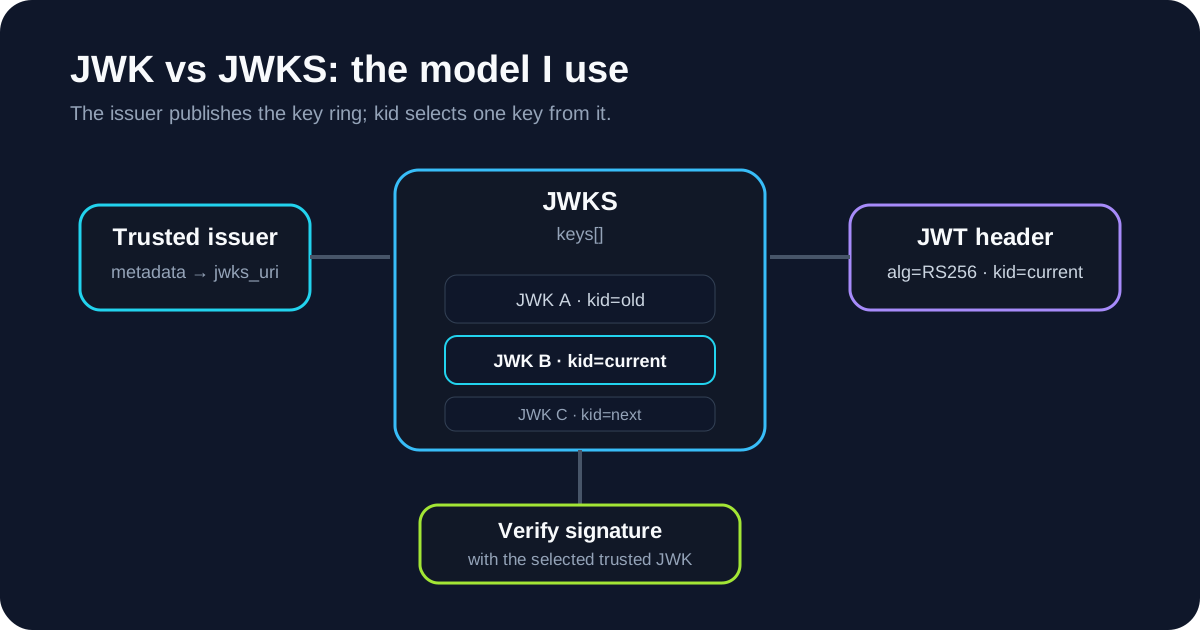
When I see JWK and JWKS in JWT documentation, I reduce the difference to one simple model:
A JWK is one JSON representation of a cryptographic key. A JWKS is a JSON object containing a set of JWKs.
That sounds small, but the distinction becomes important as soon as I deal with key rotation, multiple signing keys, kid, or a provider's jwks_uri.
If I already have a JWT and a full key set, I use the JWKS Validator because it performs the same selection process I would implement in an application: read kid, choose a compatible JWK from the trusted set, then verify the signature.
What I mean by JWK
RFC 7517 defines a JSON Web Key (JWK) as a JSON object representing a cryptographic key.
An RSA public JWK may look like this:
{
  "kty": "RSA",
  "kid": "signing-key-2026-09",
  "use": "sig",
  "alg": "RS256",
  "n": "...",
  "e": "AQAB"
}
When I read this object, I pay attention to fields such as:
kty— key type;kid— key identifier;use— intended high-level use such as signatures;key_ops— allowed key operations when provided;alg— intended algorithm when provided;- key material such as RSA
n/eor ECcrv/x/y.
A JWK is the key object itself. It is not automatically a trusted key merely because its JSON is well formed.
What I mean by JWKS
A JWK Set is defined by RFC 7517 as an object with a keys array containing JWK objects.
For example:
{
  "keys": [
    {
      "kty": "RSA",
      "kid": "key-old",
      "use": "sig",
      "alg": "RS256",
      "n": "...",
      "e": "AQAB"
    },
    {
      "kty": "RSA",
      "kid": "key-new",
      "use": "sig",
      "alg": "RS256",
      "n": "...",
      "e": "AQAB"
    }
  ]
}
In developer conversations, people commonly call this a JWKS — JSON Web Key Set.
The key difference I use is:
JWK  = one key
JWKS = container of keys
Why I usually encounter JWKS in real JWT verification
If an issuer only ever had one fixed public key, a single JWK could be enough to represent it.
Real identity systems often need more flexibility:
- key rotation;
- multiple active signing keys;
- different key types;
- different algorithms;
- staged rollout of old and new keys.
A JWKS gives the issuer a way to publish several public keys at once.
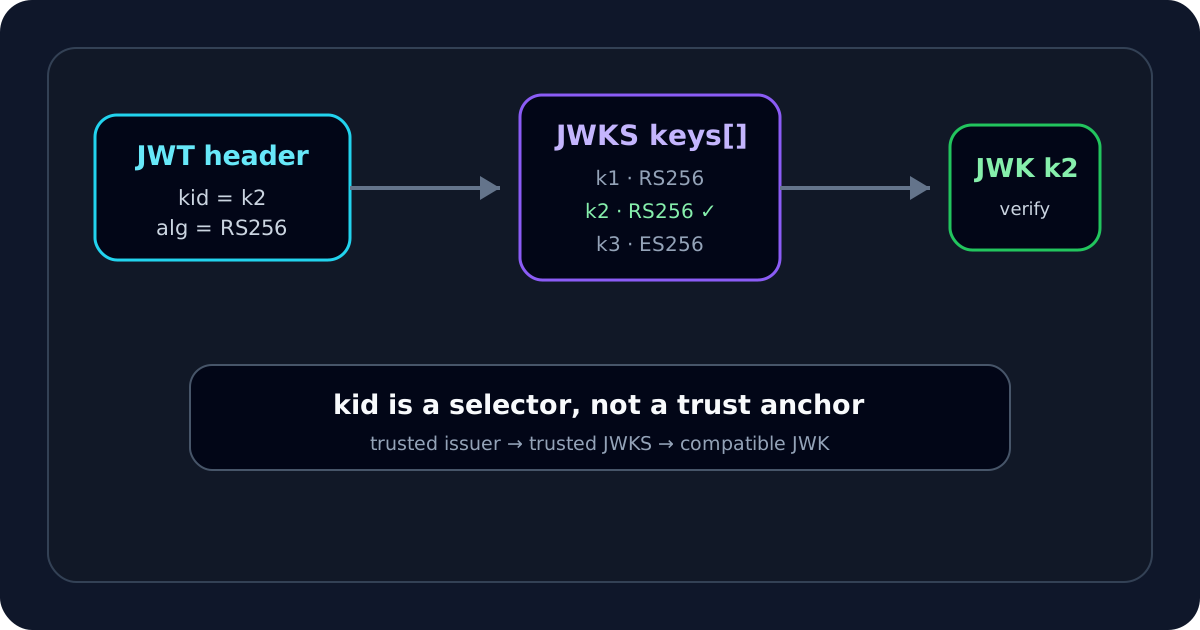
That is why a token header often includes kid:
{
  "alg": "RS256",
  "kid": "key-new"
}
I use that value to select one candidate JWK from the trusted set.
How I use kid with a JWKS
My mental model is:
JWT header kid
      ↓
trusted JWKS
      ↓
find JWK with matching kid
      ↓
check kty / alg / use / key_ops
      ↓
import key
      ↓
verify signature
I do not stop at the kid match.
A matching identifier is useful, but I still check that the key is compatible with the expected algorithm and is appropriate for signature verification.
The JWT kid guide is the troubleshooting flow I use when the identifier is missing, not found, duplicated, or stale after rotation.
When I use a single JWK
A single JWK is useful when:
- I have already selected the exact key from a trusted set;
- an API or configuration file stores one public key as JSON;
- I am importing one key into Web Crypto or a JOSE library;
- I am debugging the fields of a specific RSA or EC key.
At that point I do not need the whole JWKS for the cryptographic operation. I only need the selected key.
For example, Web Crypto can import a compatible public JWK directly:
const publicKey = await crypto.subtle.importKey(
  "jwk",
  jwk,
  {
    name: "RSASSA-PKCS1-v1_5",
    hash: "SHA-256"
  },
  false,
  ["verify"]
);
The important part is that the application selected that JWK from a trusted source and validated the surrounding policy.
When I use the full JWKS
I keep the whole key set when I still need to solve key selection.
Typical examples:
- verifying JWTs from an issuer that rotates keys;
- handling tokens with different
kidvalues; - refreshing keys when an unfamiliar
kidappears; - comparing old and new keys during a rollover;
- operating a resource server that validates tokens over time.
The JWT key rotation guide explains why old and new JWKs may need to coexist in the set during a planned rotation.
What is jwks_uri?
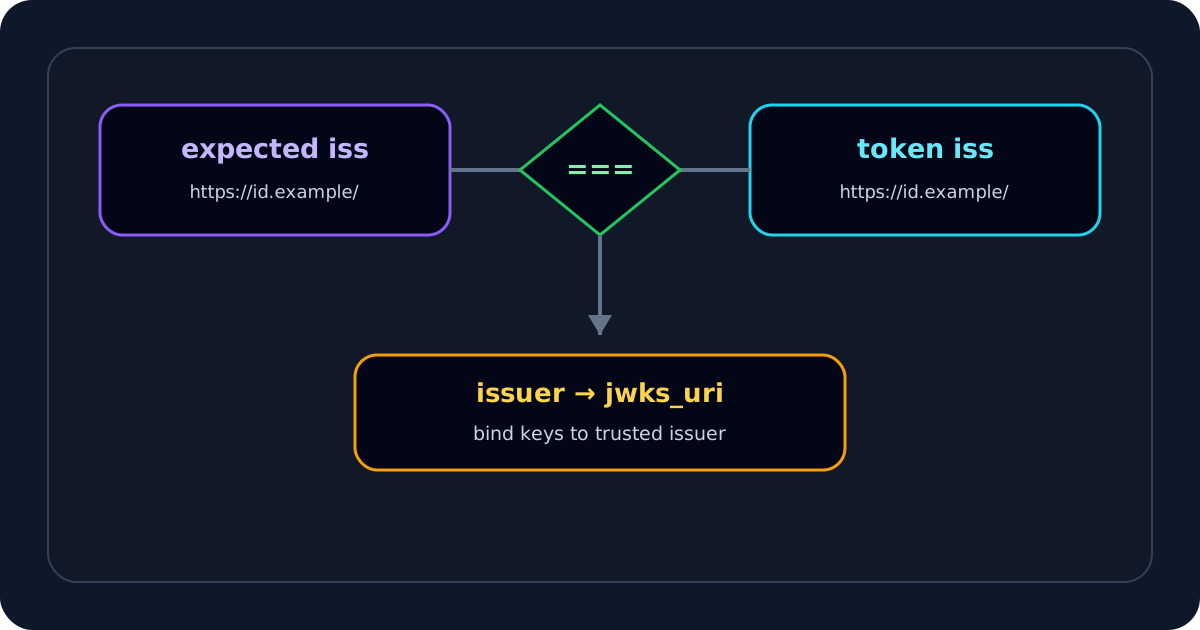
In authorization-server metadata, RFC 8414 defines jwks_uri as a URL for the authorization server's JWK Set.
Conceptually:
{
  "issuer": "https://login.example.com/",
  "jwks_uri": "https://login.example.com/.well-known/jwks.json"
}
I use that relationship as part of the issuer trust chain:
configured/trusted issuer
        ↓
trusted metadata
        ↓
jwks_uri
        ↓
JWKS
        ↓
JWK selected by kid
I do not reverse that logic and say:
The JWT mentioned a URL, so I will trust whatever keys are there.
The issuer relationship has to be established from trusted configuration or trusted metadata first.
JWK versus PEM: how I think about it
A JWK is a JSON representation of key material. PEM is a text encoding/container format commonly used for ASN.1 key or certificate data.
The same RSA public key can often be represented either as:
-----BEGIN PUBLIC KEY-----
...
-----END PUBLIC KEY-----
or as a JWK containing kty, n, and e.
I choose based on the system I am integrating with.
- Browser Web Crypto works naturally with JWK import.
- Many server libraries accept PEM.
- Identity providers commonly publish public keys as JWKS.
The representation changes; the trust decision does not.
Why use, key_ops, and alg matter
A JWK may contain metadata describing how it is intended to be used.
For signature verification I pay attention to:
{
  "use": "sig",
  "key_ops": ["verify"],
  "alg": "RS256"
}
Not every key includes all of these optional members, but when they are present I expect them to be semantically compatible with the operation I am performing.
For example, if a JWK explicitly says:
{
  "use": "enc"
}
I do not select it as a JWT signing-verification key simply because its kid matches.
The JWKS Validator on this site applies those compatibility checks before importing a candidate key.
JWK versus JWKS during key rotation
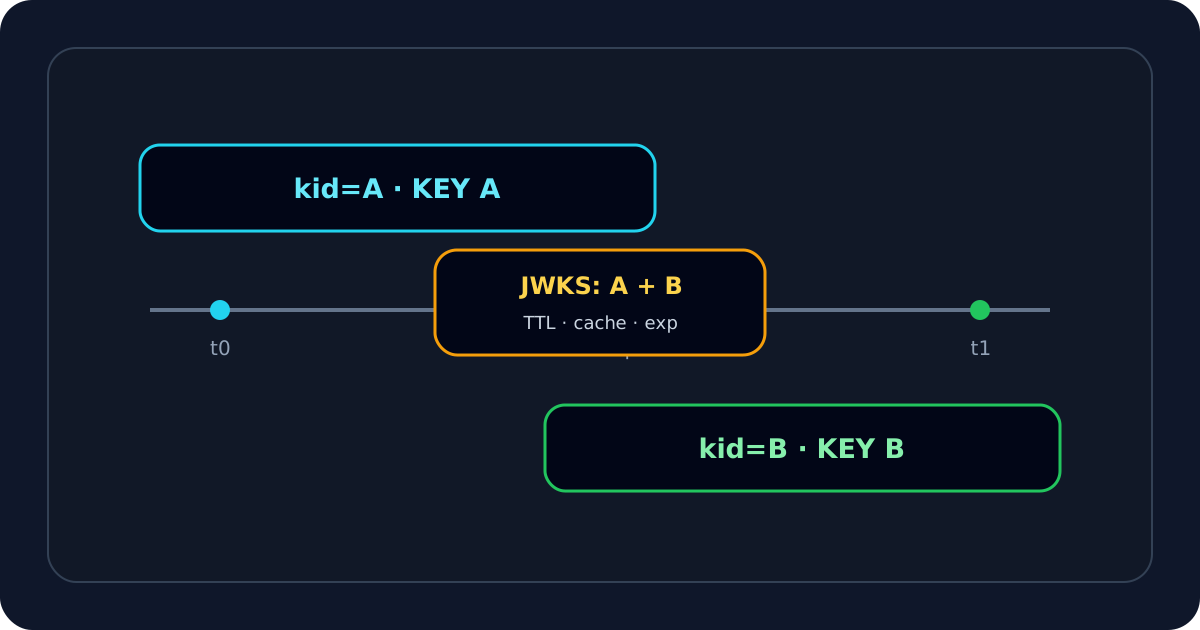
Key rotation is the situation where the distinction becomes easiest to see.
Before rotation:
JWKS
└── JWK A
During planned overlap:
JWKS
├── JWK A (old)
└── JWK B (new)
After old tokens no longer need JWK A:
JWKS
└── JWK B
The JWT's kid tells the verifier which JWK to try from the current trusted set.
That is why removing an old JWK too quickly can break still-valid tokens, while leaving a compromised key trusted too long can create a security problem. Rotation policy has to reflect why the key changed.
What I check before trusting a JWK from a JWKS
My checklist is:
- I confirm which issuer the application trusts.
- I obtain the JWKS from the issuer's trusted configured or metadata-derived location.
- I read the JWT's
kidonly as a selection hint. - I find the candidate JWK.
- I check
ktyagainst the expected algorithm family. - I check
alg,use, andkey_opswhen present. - I import the key using the intended verification algorithm.
- I verify the JWT signature.
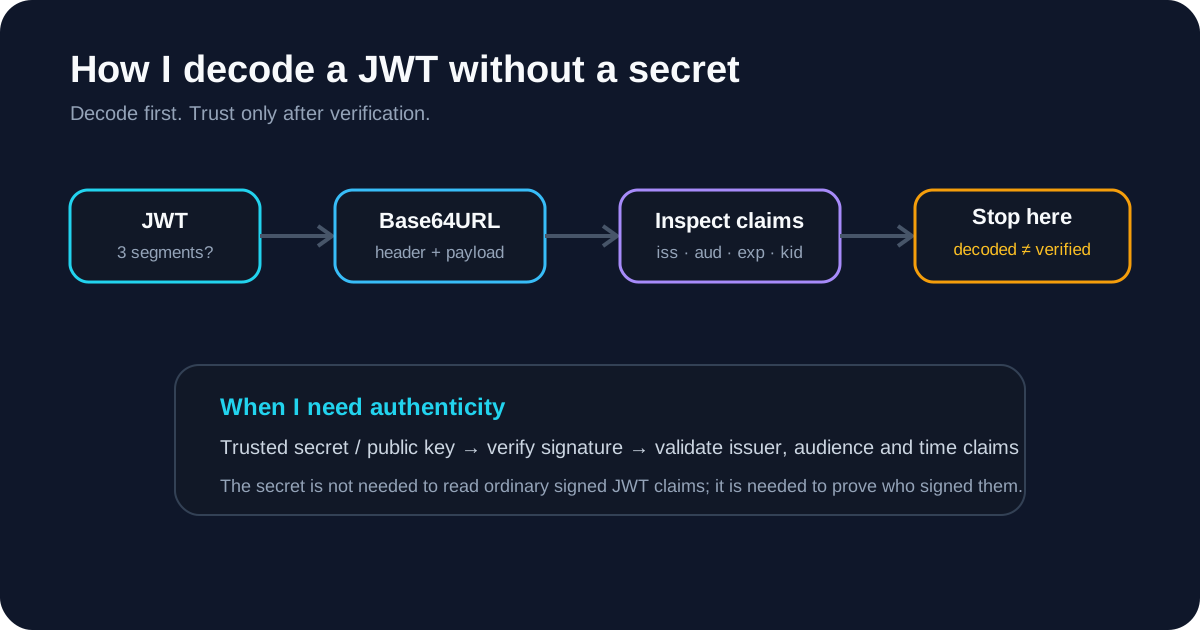
- I still validate issuer, audience, expiration, and token type afterward.
A JWK that imports successfully is not automatically trusted. A JWKS that parses successfully is not automatically associated with the right issuer.
My shortest JWK vs JWKS rule
When I need to explain the difference to myself, I use this:
JWK is the key. JWKS is the key ring.
kidhelps me choose which key from that ring to try.
Then I add the security part:
The key ring has to come from a source I already trust for the expected issuer.
That is the distinction that matters most in real JWT verification.