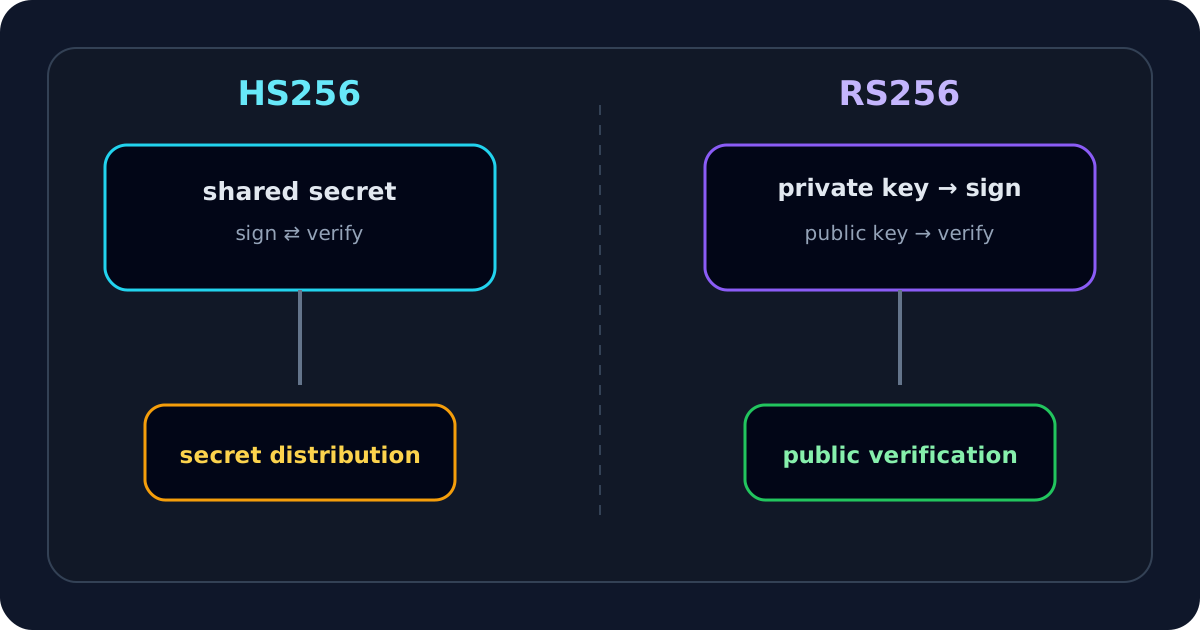
When I choose between HS256 and RS256, I do not start with “which algorithm is stronger?” I start with a trust-boundary question: who needs to sign tokens, who only needs to verify them, and how many systems need access to key material?
That question usually makes the choice much clearer than a generic “HS256 vs RS256” comparison.
If I already have a token and trusted key material, I use the JWT Signature Verifier to test both algorithm families and inspect how the verification inputs differ.
The mental model I use for HS256
HS256 is HMAC using SHA-256.
The same shared secret is used for signing and verification:
shared secret
   ├── signs JWT
   └── verifies JWT
When I give a service the HS256 secret so it can verify tokens, I have also given that service enough material to create signatures that other holders of the same secret may trust.
That can be completely acceptable in a small, tightly controlled trust boundary. It becomes more important as the number of verifiers grows.
The mental model I use for RS256
RS256 uses RSA PKCS#1 v1.5 signing with SHA-256.
The key roles are separated:
private key  -> signs JWT
public key   -> verifies JWT
When I distribute the public key to an API, that API can verify signatures without gaining the private signing capability.
That separation is the reason I often prefer asymmetric signing when one identity provider issues tokens consumed by many independent services.
The first question I ask: who is allowed to mint trusted tokens?
If one service signs and verifies its own tokens and the secret can remain inside one small boundary, HS256 may be simple and appropriate.
If a central authorization server signs tokens for many APIs, I generally prefer a model where those APIs can verify without also becoming potential signers. That pushes me toward RS256 or another asymmetric scheme.
I therefore treat algorithm choice as an authority-distribution decision, not just a cryptographic primitive decision.
When HS256 makes sense to me
I consider HS256 when:
- the signer and verifier are inside one tightly controlled system;
- secret distribution is limited and manageable;
- there is no need to publish a public verification key;
- operational simplicity matters;
- every holder of the secret is intentionally trusted with signing capability.
The secret still has to be strong. RFC 8725 warns against weak human-memorable HMAC secrets because signed JWTs can enable offline guessing attempts.
I do not use a short password merely because it is easy to put in an environment variable.
When RS256 makes more sense to me
I lean toward RS256 when:
- a central identity provider signs tokens;
- many APIs need to verify them;
- verifiers should not be able to mint new trusted tokens;
- public keys need to be distributed widely;
- key rotation is handled through a public JWK/JWKS mechanism.
A leaked RSA public key is not supposed to let an attacker produce valid RS256 signatures. The private key remains the high-value signing credential.
Why I do not say “RS256 is always more secure”
Both algorithms can be deployed badly.
HS256 becomes risky when:
- the secret is weak;
- the secret is copied across too many services;
- one verifier compromise exposes signing capability;
- key encoding is inconsistent;
- the verifier accepts unexpected algorithms.
RS256 becomes risky when:
- the private key is poorly protected;
- the verifier trusts arbitrary public keys;
- stale or wrong keys are selected after rotation;
- issuer and audience validation are skipped;
- algorithm policy is derived from untrusted token data.
So I choose the key model that fits the architecture, then secure that model correctly.
Why I pin the algorithm explicitly
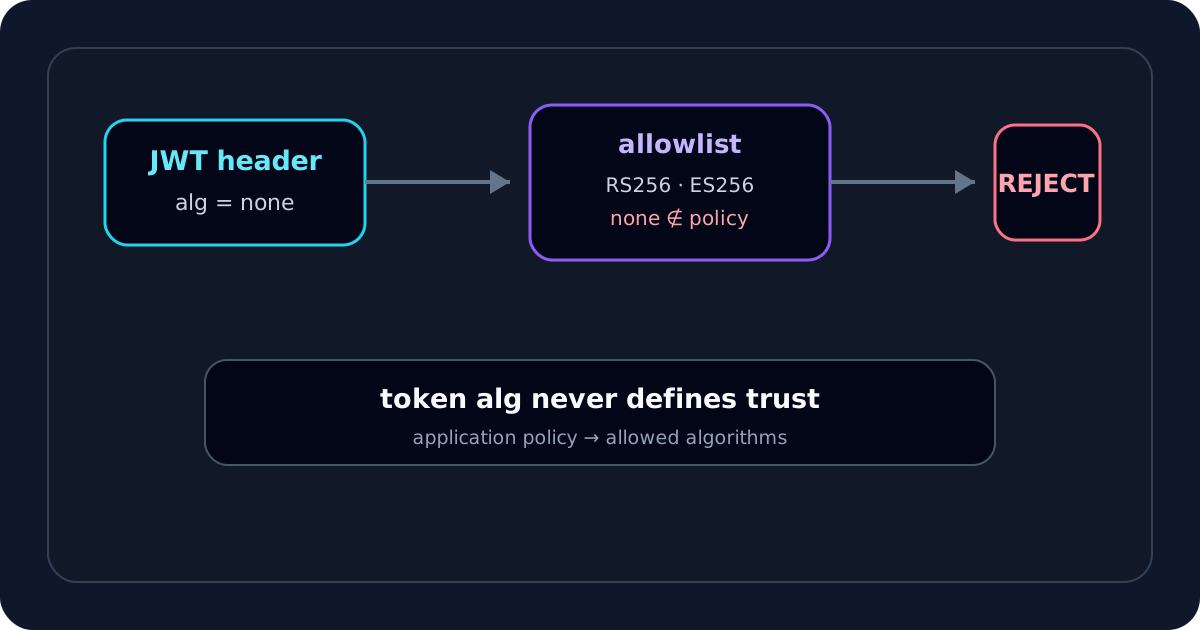
I never want an untrusted JWT to decide the verifier's algorithm policy.
RFC 8725 recommends configuring the supported algorithm set explicitly. I treat that as mandatory design discipline.
If my application expects RS256, I do not dynamically switch to HS256 because the token header changed. Historic JWT algorithm-confusion bugs are exactly why I keep key type and allowed algorithm tied to application configuration.
How I think about key distribution with HS256
Imagine three APIs verifying the same HS256 tokens:
auth server -- shared secret --> API A
            -- shared secret --> API B
            -- shared secret --> API C
If all four systems know the same secret, all four can potentially create signatures accepted by the others.
That does not mean HMAC is cryptographically broken. It means I need to be comfortable with that trust relationship.
If I am not comfortable with it, I change the architecture rather than pretending the shared secret is “verification-only.”
How I think about key distribution with RS256
With RS256, I can keep the signing key centralized:
auth server keeps private key
         |
         +--> API A gets public key
         +--> API B gets public key
         +--> API C gets public key
That is a cleaner boundary when independent services only need verification capability.
It also aligns naturally with JWKS-based public-key distribution and rotation.
Where kid enters the picture
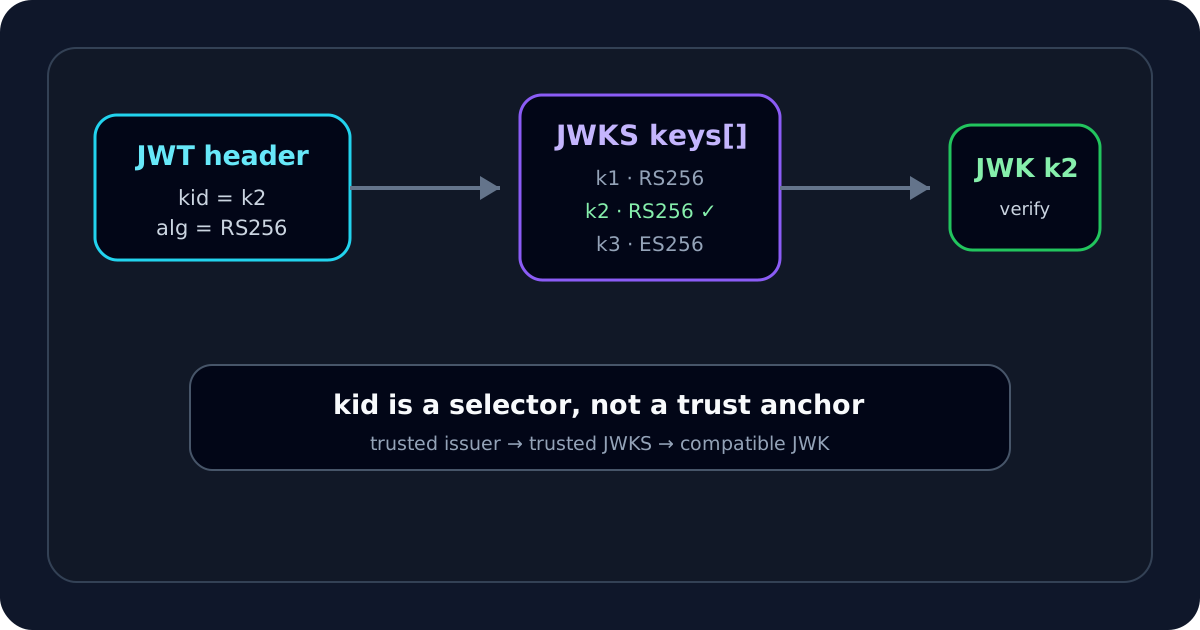
With rotating asymmetric keys, a JWT header may contain:
{
  "alg": "RS256",
  "kid": "2026-key-03"
}
I read kid as a hint that helps the verifier select the matching trusted public key.
I do not treat kid itself as proof that the key is trusted. The key set must already be anchored to a trusted issuer.
This is why jwt kid and verify jwt with jwks are natural next topics for this site: they explain the step between reading an RS256 header and selecting the correct public key safely.
Can I decode either algorithm without the key?
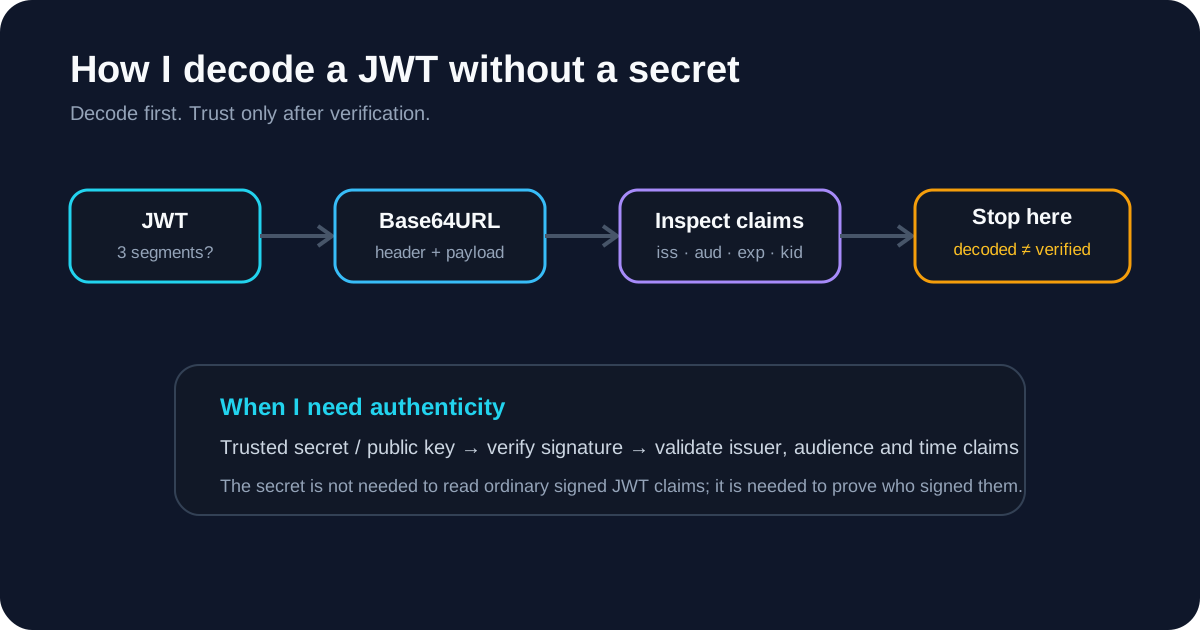
Yes, for ordinary signed JWTs.
HS256 and RS256 change how the signature is produced and verified. They do not encrypt the normal header and payload.
So I can inspect either token with the JWT Decoder without the secret or private key. I only need key material when I move from “what does it say?” to “was it signed by the party I trust?”
The decode JWT without a secret guide covers that boundary in detail.
My HS256 checklist
Before I choose or debug HS256, I ask:
- is the shared secret strong and randomly generated?
- how many systems receive it?
- am I comfortable giving each verifier signing capability?
- is the secret interpreted consistently as bytes?
- is the allowed algorithm pinned explicitly?
- are secrets rotated without leaving stale copies everywhere?
My RS256 checklist
Before I choose or debug RS256, I ask:
- where is the private key stored and protected?
- how are public keys distributed?
- how does
kidselect a key during rotation? - is the key source tied to the trusted issuer?
- does the verifier reject unexpected algorithms?
- are issuer, audience and time claims validated after signature verification?
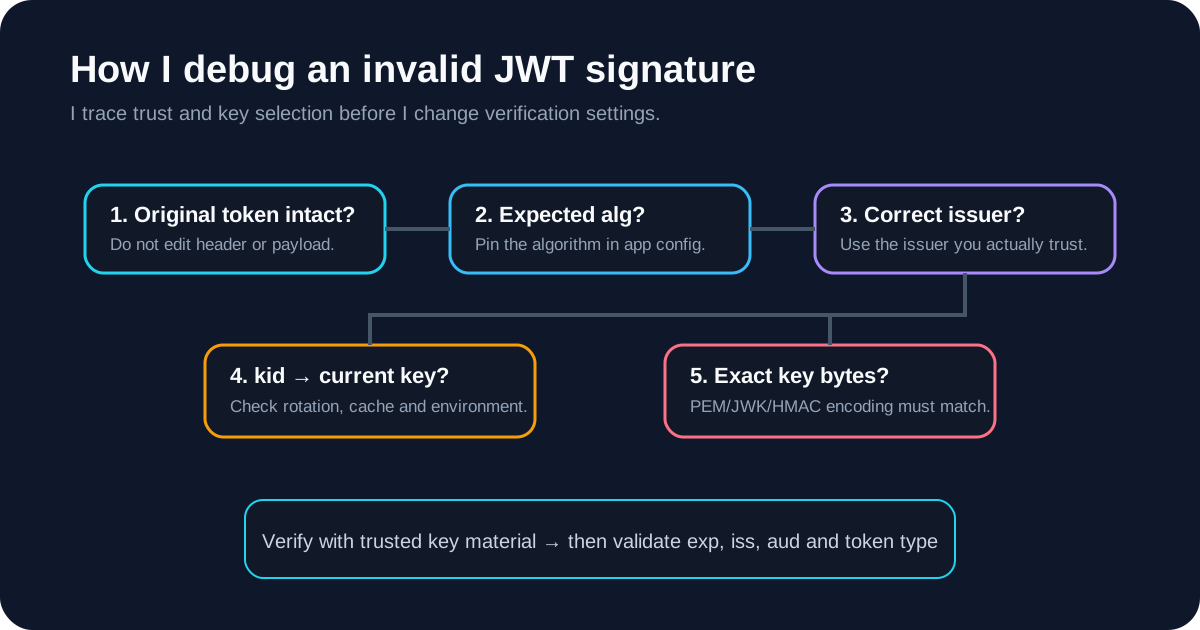
For a failed signature, I use the JWT invalid signature guide instead of changing algorithms until something passes.
The decision rule I use
My practical rule is:
- I choose HS256 when a shared-secret trust boundary is genuinely appropriate and every secret holder is intentionally trusted to sign.
- I choose RS256 when I want one signer and many verifiers without distributing signing authority.
Then I pin the allowed algorithm, protect the signing credential, manage rotation deliberately, and validate the token's issuer, audience and time claims.
The biggest lesson for me is that HS256 vs RS256 is really about key ownership and trust distribution. The algorithm name is only the visible part of that architecture.